Data Platform Redefined: How AI Agents, Metadata-Driven Data Integration, and SAS Viya Are Changing the Game

Technology vendors often focus on database performance, analytics, AI/ML, and BI capabilities. But what about the foundation that makes all these possible? Data integration is one of the most complex and least visible parts of a modern data platform, yet it plays a critical role in long-term scalability, governance, and reliability.
In our previous article, “Metadata-Driven ETL: Delivering New Data Assets Faster”, we explored how metadata-driven automation can simplify enterprise data integration, reduce development effort, and improve operational efficiency. Now, AI agents add a new possibility: creating integration metadata through natural-language prompts.
At the heart of this evolution is a Metadata-Driven Data Integration Solution (MDIS), where metadata controls the behavior of integration processes, rather than requiring developers to manually code individual ETL/ELT jobs.
This article explores how AI agents, metadata-driven automation, and SAS Viya work together to support scalable, intelligent data pipelines and help organizations build a foundation for trusted, AI-ready data.
Key Takeaways
- In MDIS, metadata controls integration processes rather than requiring developers to manually code individual ETL/ELT jobs.
- AI agents introduce a new way to create integration metadata through natural-language prompts, while the metadata-driven execution model remains unchanged.
- Metadata-driven automation can help organizations reduce development and maintenance effort, accelerate project delivery, and improve control over costs, timelines, and resources. MDIS has established deployments across banking, insurance, and the public sector.
The Evolution of Data Integration: From Classic to Metadata-Driven
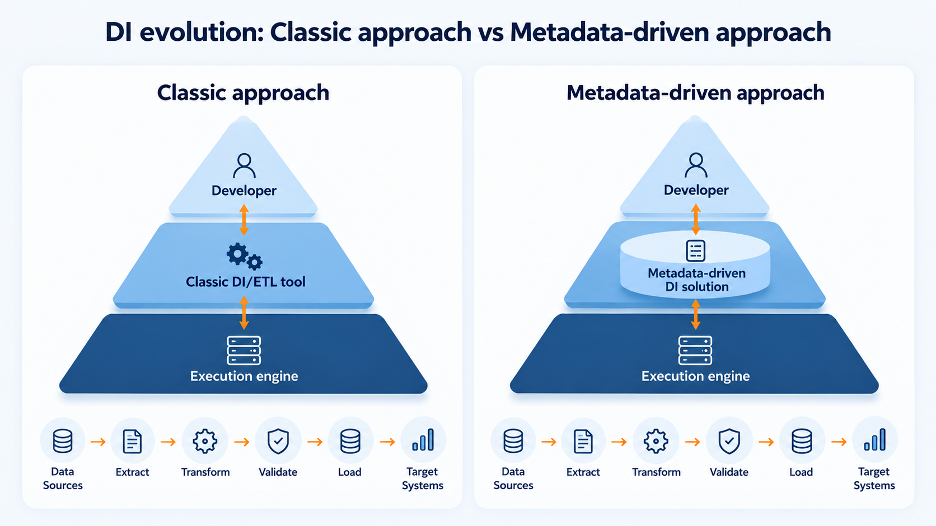
The key difference between classic and metadata-driven data integration lies in what drives the integration process.
In traditional Data Integration(DI/ETL) tools, developers build static data pipelines consisting of predefined data transformations. These transformations serve as input to the execution engine.
With a metadata-driven approach, the process changes. Instead of manually building individual pipelines, developers define metadata that drives their generation. In this model, metadata determines the integration processes executed by the engine, rather than relying on individually defined transformation flows.
This represents a fundamental shift: from manually defined data transformations to metadata-driven data integration processes.
Smart Data Integration Capabilities
Beyond automating pipeline development, Smart Data Integration (DI) uses metadata to control and automate data processing, validation, historization, and execution.
MDIS brings together advanced capabilities to simplify complex data integration processes, including:
- Metadata-driven automation: Automatically determines processing order, manages validity periods, and supports complex data loading from multiple sources.
- Data processing and quality management: Enables record-level transformations, multi-step validations, customizable error handling, and user-defined processing logic.
- Data historization and change tracking: Supports historized dimensions and facts, historical data modifications, and change tracking across different periods.
- Intelligent execution: Provides automatic re-execution of affected processes, execution monitoring, and parallel processing across multiple levels.
Together, these capabilities enable more automated, flexible, and controlled data integration processes, reducing manual development effort and improving operational efficiency.
DI Evolution: Metadata-Driven Data Integration Meets AI
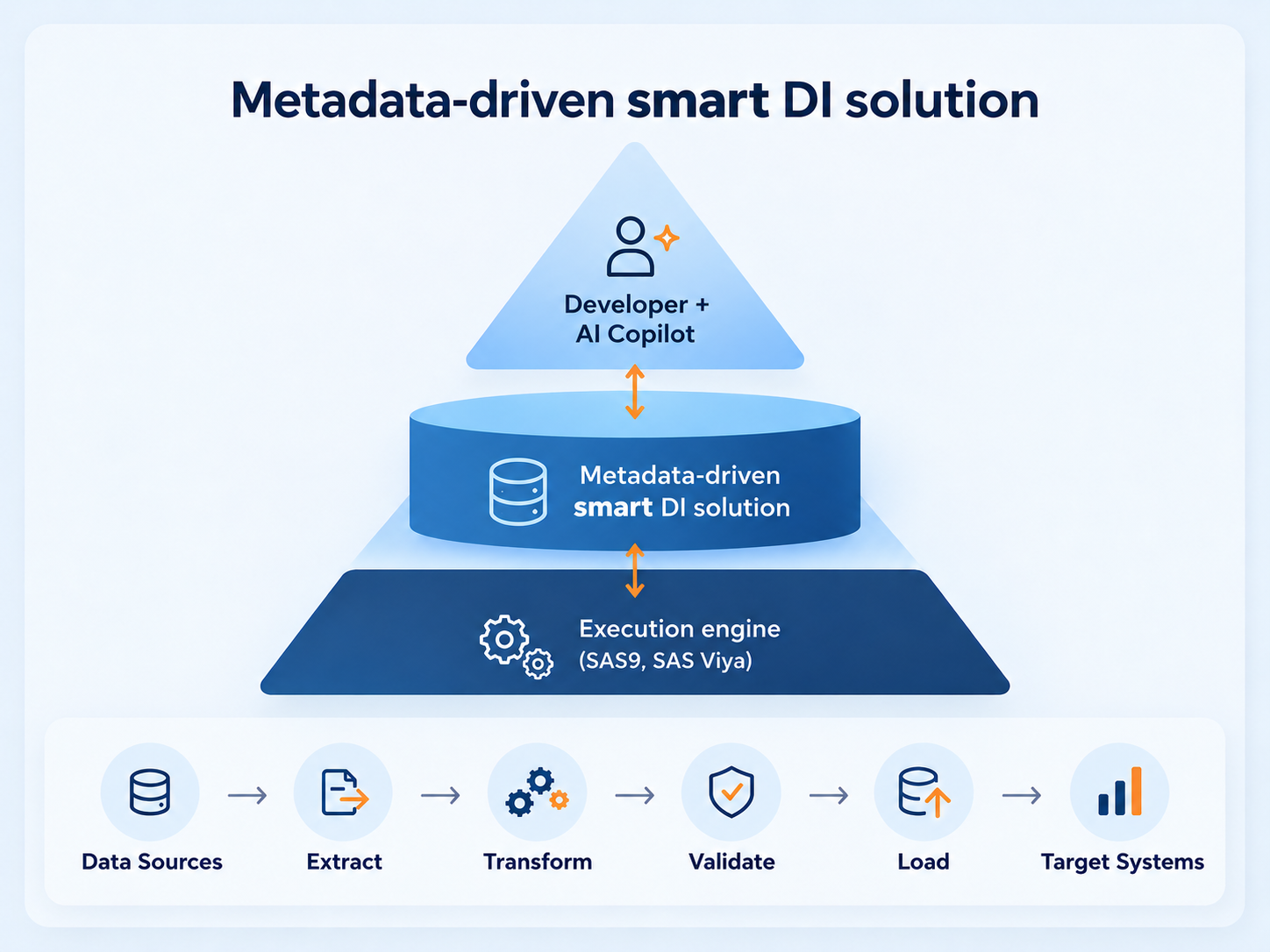
The next step in the evolution of data integration brings together metadata-driven automation and AI agents on the SAS Viya platform.
In MDIS with integrated AI agents, developers can create integration metadata through natural-language prompts.
Instead of defining metadata entirely manually, developers provide natural-language instructions that AI agents use to create DI metadata. This metadata, in turn, drives the integration processes executed by the engine.
The fundamental principle remains the same: metadata drives the integration processes, while AI agents introduce a new way to create that metadata.
This combination can simplify how developers define integration processes while preserving the underlying metadata-driven execution model.
Metadata-Driven Approach + AI: Benefits & Value
Combining smart metadata-driven data integration with AI agents introduces benefits not only in how integration processes are developed and maintained, but also in how projects can be delivered.
By reducing manual development effort and simplifying maintenance, this approach can help organizations:
- Lower implementation and maintenance costs by reducing repetitive development work.
- Accelerate project delivery, potentially allowing smaller teams to manage complex implementations.
- Improve delivery predictability, with greater confidence in meeting planned timelines, budgets, and resource requirements.
- Reduce project risks through more precise estimation, simplified testing and maintenance, and easier implementation of changes
- Deliver "impossible projects" that cannot be implemented efficiently using traditional approaches.
The result is greater control over costs, timelines, and project scope, making complex data integration initiatives more manageable and predictable.
MDIS has proven deployments across banking, insurance, and the public sector, demonstrating its applicability to complex enterprise data management environments.
MDIS Integration with SAS Viya and SAS 9
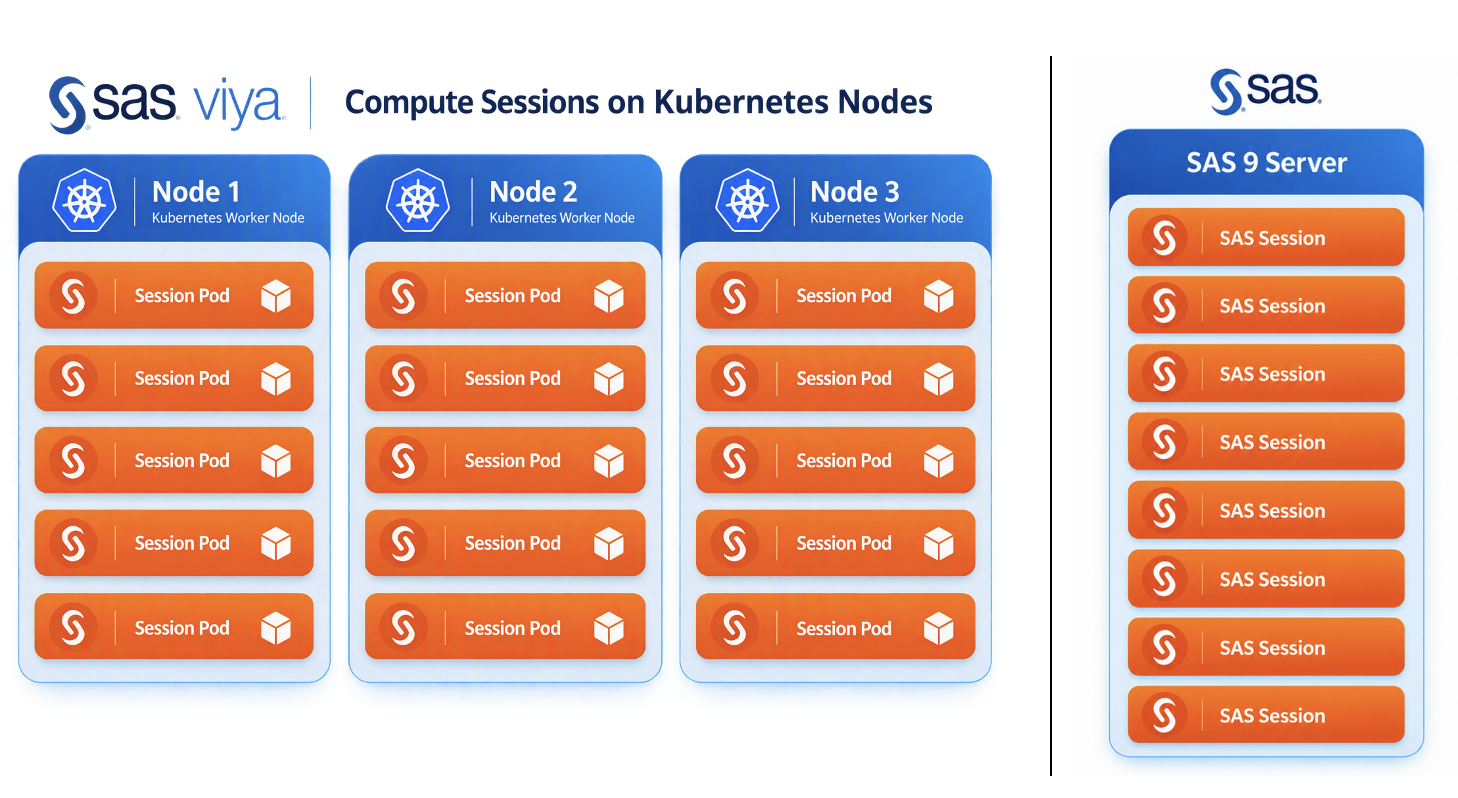
MDIS-generated data pipelines integrate with both SAS Viya and SAS 9, leveraging the execution capabilities of each platform.
On SAS Viya, generated data pipelines integrate with its scalable architecture through SAS Compute Server sessions.
On SAS 9, integration is achieved through parallel sessions using the MP CONNECT functionality of SAS/CONNECT.
This enables organizations to apply the metadata-driven approach across different SAS environments.
Processing Large Structured Data (10 TB+)
Beyond platform integration, MDIS also supports the processing of large, structured datasets (10 TB+) through partition-based data management.
Large tables are physically stored assets of partitions, while developers can continue working with them in the same way as with standard MDIS table aliases, with some additional configuration settings.
Developers can define how data is partitioned—for example, by date, region, or identifier—according to specific processing requirements. These partitions are then refreshed in parallel sessions.
This approach combines metadata-driven development with partition-based processing, enabling organizations to manage large, structured datasets while maintaining a consistent development approach.
Conclusion
Redefining the modern data platform is not only about more powerful analytics or AI capabilities. It is also about how data is integrated, managed, and governed.
By bringing together AI agents, Smart Metadata-Driven Data Integration, and SAS Viya, MDIS offers an approach to large-scale structured data integration that can increase agility, reduce operational costs, and help organizations build a reliable foundation for analytics and AI.
Because the future of AI-ready data platforms starts with how data is integrated.
As a SAS partner, we help organizations implement and evolve metadata-driven data integration through MDIS Data Management. If you're exploring how AI-assisted metadata creation and SAS Viya could support your data integration initiatives, we'd be happy to discuss your needs.